Saturday, June 14, 2014

Mounds At A Mental Hospital

The Mendota Mental Health Institute in Madison, Wisconsin was built on a plot of land that already contained several groups of effigy mounds.  Its buildings were thus located to keep the mounds intact.  Because of the nature of the place, we were advised not to go wandering off during our visit.

This group of conical mounds is located near the old superintendent's house.

These two trees are rooted in one end of a mound that is thought to represent a bear as seen from above, in other words, an "aerial view bear".

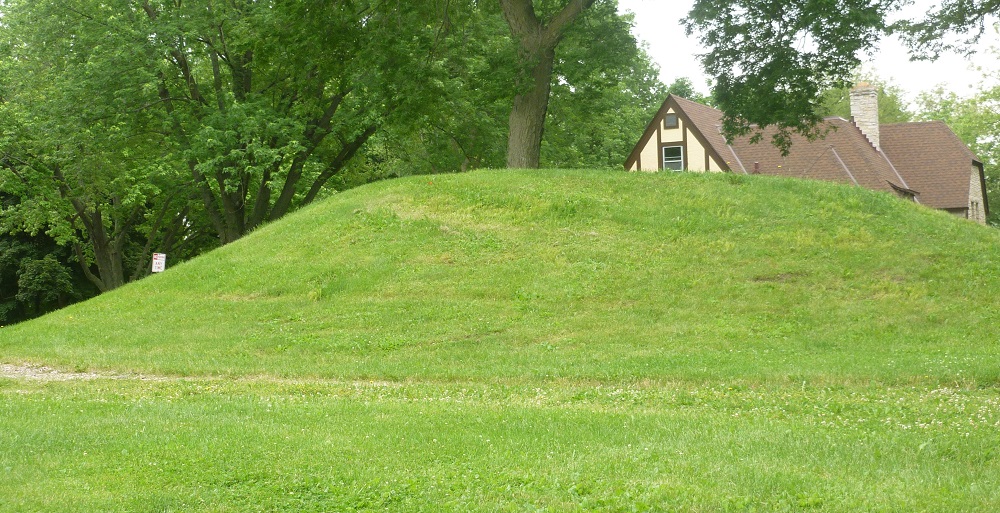
Here's a closer view of the largest of the three conical mounds, with the old superintendent's house behind it.
In another part of the MMHI grounds is an effigy mound with a long curved "tail", with trees growing out of it.

These straight embankments with sharp corners form part of a bird effigy mound.

This is part of another bird effigy.

This two-lobed mound is thought to represent a small animal such as a beaver.  The trees are not growing on the mound, but are behind it.

A mental institution might seem an odd place to find Indian mounds, but 12 years ago, I visited a site that I would consider even more unusual, a golf course.

Man Mound

Just northeast of Baraboo, Wisconsin is the only remaining effigy mound in the state that is shaped like a human.  The "head" of the mound includes two protrusions which are sometimes referred to as "horns".  The mound and its namesake park are located just off its namesake road.  Here are two signs next to the mound.

This shot looks up from the "legs" of the mound.  The two ladders were set up near the "head", to give a slightly elevated view for anyone making a short climb.

During the construction of Man Mound Road, the "feet" and lower parts of the "legs" were destroyed.  The white paint indicates where they used to be.

Across the road were some local residents.

This last shot was taken after climbing one of the ladders, and looks down from the "head" of the mound.  The two "horns" can easily be seen.


Friday, June 13, 2014

A Swing Into Iowa

After viewing several mound sites in Wisconsin, we went over to Iowa, to visit Effigy Mounds National Monument and Pikes Peak State Park, both of which are close to the Mississippi River.  Looking east from the visitor center at Effigy Mounds NM, the closer body of water (with the two men fishing from their boat) is Bluegill Pond.  On the other side of the railroad tracks is the Mississippi, beyond which is Wisconsin.

This group of conical mounds is a short walk from the visitor's center.

This path leads up to several groups of mounds within Effigy Mounds NM.  We didn't get to see any of them because the bus could not (and did not try to) travel on the back road leading to them.

Over at Pikes Peak SP, the Bear Mound was a short distance from the parking lot.  Here's part of the mound, mainly the lower part of the "bear".

Some archaeological tourists take a walk around the "bear".

Pikes Peak is set on a bluff above the Mississippi, and thus included some great viewing areas.  This view looks north, with Prairie du Chien, Wisconsin in the background.

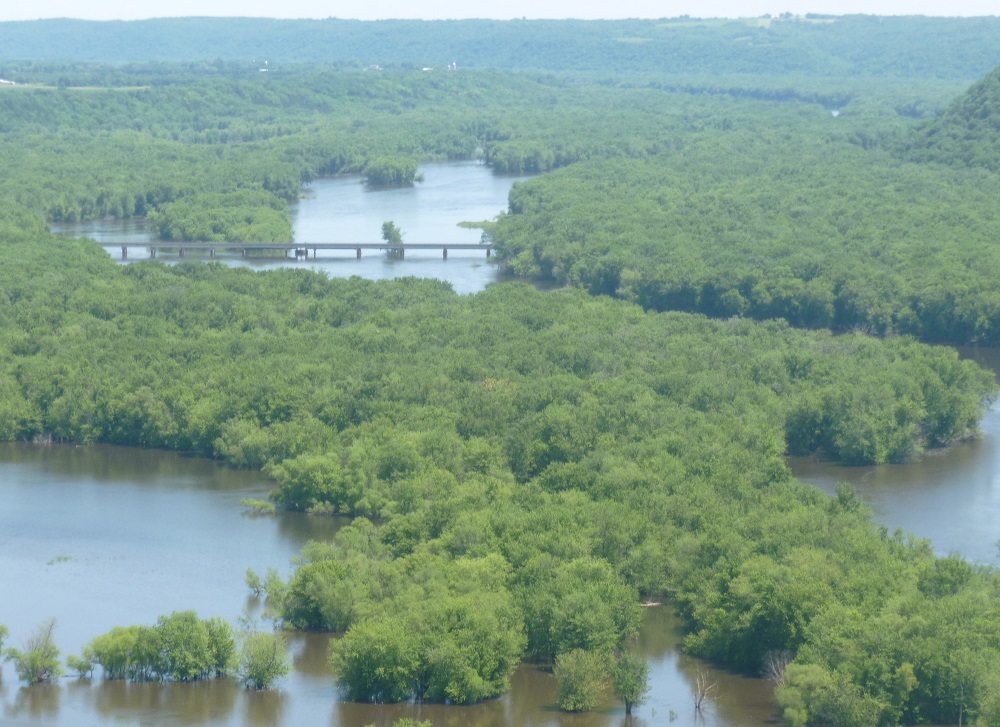
Looking east, we could see a railroad bridge span the mouth of the Wisconsin River as it empties into the Mississippi.


Thursday, June 12, 2014

Kingsley Bend Mounds

The Kingsley Bend Mounds are located a few miles east of Wisconsin Dells, and are sacred to the Ho Chunk Indians.  When we arrived, I thought that this hill might be a mound, but as it turned out, only the very top was man-made.

The mound on top of the hill can be more easily seen from this angle.

Next to the hill was this row of conical mounds.

Behind the hill and conical mounds was a downward bluff, and what I call a "modern intrusion".

A closeup of the sunlit side of the mound on the hill.

At another site near Wisconsin Dells, just off a back road, one of our archaeologist hosts tells us about raised garden beds, as he stands in the ditch between two of them.  During the 11th century, native people planted crops on the raised beds while allowing water to flow in the adjacent ditches.


Lizard Mound Park

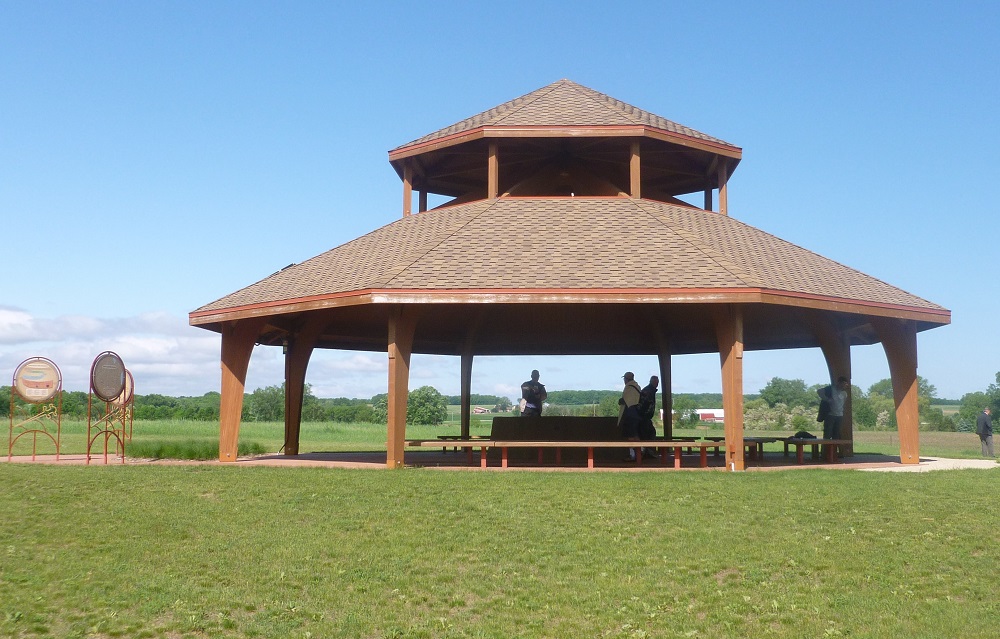
I've spent most of the last week running around several Midwestern states, including taking a tour of archaeological sites in Wisconsin and Iowa.  Most of the places we saw featured effigy mounds, which are shaped to resemble various animals or in rare cases a human, and have a height of just a few feet.  Interspersed with the effigy mounds are circular ("conical") mounds and others shaped like a straight line.  The first place we visited was Lizard Mound Park, just north of West Bend, Wisconsin.  The park includes this pavilion and several informative signs.

Here's the "Welcome" sign, held by a frame that includes a beige outline of one common type of effigy mound shape.

Here's a close up of the "Welcome" sign.

This mound is long and straight, and is shown from one end thereof.

It's hard to tell that there's a mound here, because of the high grass growth.

Another mound is overgrown with grass and wild flowers.

Several trees have taken root in this long straight mound.

The footpath goes between two mounds.

No mounds here, just a nice place to break for lunch.  This is River Bend Park in Horicon, Wisconsin.

Of course, no placed named "River Bend" would be complete without a river.

For more information on Lizard Mound Park, go to Wisconsin Historical Markers.

Tuesday, June 10, 2014

House GOP Leader Loses In Primary

Eric Cantor (R-VA), the sitting House Majority Leader, has lost to a political newcomer in his party's primary election.  Dave Brat, who is currently a professor at Randolph-Macon College, will run as the Republican nominee against Democrat Jack Trammell, who is likewise....you guessed it....a professor at Randolph-Macon.  As the saying goes, you can't make this stuff up.

Read the story at USA Today, The Washington Post, Fox News and the National Journal.

Friday, June 6, 2014

D-Day Plus 70 Years

Today is the 70th anniversary of D-Day, when Allied forces landed at the beaches of Normandy, starting the liberation of France and the western advance into Germany.  Anyone familiar with this blog knows that I recently visited the area, including parts of Utah and Omaha Beaches, and even the site of an artificial harbor built by the British.  There isn't much I can add, but I found a "Your Questions Answered" page at the British site D-Day Museum & Overlord Embroidery.  Here's one example:
Which Allied nations took part in the fighting?
The majority of troops who landed on the D-Day beaches were from the United Kingdom, Canada and the US. However, troops from many other countries participated in D-Day and the Battle of Normandy, in all the different armed services: Australia, Belgium, Czechoslovakia, France, Greece, the Netherlands, New Zealand, Norway and Poland.
To learn more, click on the above link and browse around.

Thursday, June 5, 2014

D-Day Paratrooper Jumps Again

On June 6, 1944, paratrooper Jim "Pee Wee" Martin jumped out of an airplane and landed at Utah Beach, during an early phrase of the D-Day invasion of Normandy, France.  Today, at age 93, he commemorated his feat by repeating it, but this time without any Germans shooting at him.

Read more at CBS News, Huff Post Politics and CNN.

From Smokie: Ronald Reagan Passed Away Ten Years Ago

From Smokie, one of my friends at BlogTalkRadio, at his blog Somewhere in Texas:
Ten years ago on June 5, 2004, Ronald Wilson Reagan, the 40th president of the United States, died, after a long struggle with Alzheimer's disease. Reagan, who was also a well-known actor and served as governor of California, was a popular president known for restoring American confidence after the problems of the 1970s and helping to defeat communism.

Wednesday, June 4, 2014

Some More Pictures From DC

Today I went back down to Washington to see if anything was going on with Operation American Spring.  My friend Movin Forward also showed up, but most of the organizers were not around.  As it turned out, they were moving from a camp where they were staying, somewhere outside of the District, over to another camp.  The meeting place, known as Camp Liberty, however, will stay where it is.

As a result of this situation, I got a chance to see some sights, and get some exercise.  Here are your tax dollars at work.  Near the Washington Monument, a new building is under construction.

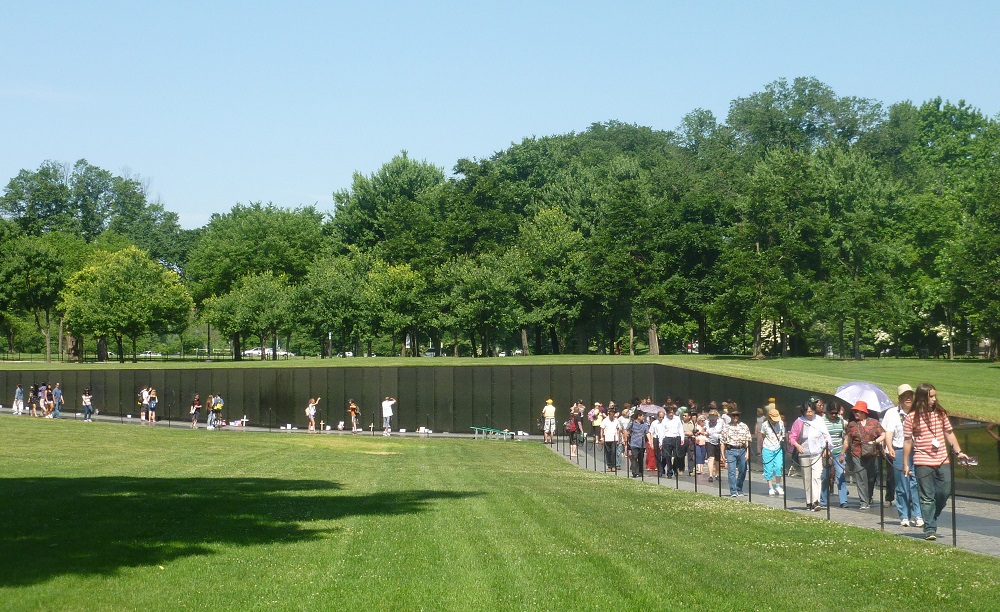
This is the Vietnam War Memorial, with a good number of visitors.

Within the grounds of the World War II Memorial, this ensemble of young singers was performing.

Here's a "look down the Mall" shot from near Camp Liberty, showing the Washington Monument and at left, the Smithsonian "Castle".

This is the large fountain in front of Union Station.

Also in front of Union Station is this bell, which is similar to the Liberty Bell in Philadelphia.