Thursday, June 25, 2015

Lago D'Orta, Part 2

After visiting Isola San Giulio, we got back on the boat (which coincidentally was again the Valentina, seen in Part 1) and rode over to Orta, a town on a peninsula projecting from the east side of its namesake lake.  As we pulled out of Isola San Giulio, I got a shot of the area just east of the dock, including much of the church.

The island and the town form a comune named Orta San Giulio.  Somewhere between the two parts, I got one last shot at the island, from its east side.

Next to the Orta's main square, the Piazza San Giulio, is the Palazzo della Comunità (Community Palace), which is supported by columns and no longer in use.  A tourist (not from my group) doesn't quite seem to know where to go.

As we wandered northward on Via Bossi, we came across this example of Italian recycling, in which an old boat is now a public bench.

We passed through the new town hall, behind which was this garden.

Beyond the orange fresco was another garden area, right next to the lake.

I liked the old building with the stone roof.

Going east from the main square leads uphill to the Santa Maria Assunta church.

After visiting Orta, we had one more boat ride (this time not on the Valentina) to Pella on the west shore of Lago D'Orta, where we met our bus for the ride back to Stresa.   On the other side of the street from the dock was the Chiesa San Filiberto.

Pretty soon, we were back in Stresa for some more free time, on our last full day in Italy.  There's more about Orta San Giulio at Eat Travel Bliss, The Guardian and The New York Times.

Lago D'Orta, Part 1

During our last full day in Italy, we visited some places on Lago D'Orta, which like Lago Maggiore is long and narrow, but overall much smaller, only about 6 miles from north to south.  The north end of Lago D'Orta is about 5 miles west of Stresa as the crow flies, but the driving distance was more like 7 or 8 miles.  Our first stop was a small town named Pettanasco, on the east side of the lake and about midway between its two ends.  We got off the bus near this church, which had a separate bell tower.  The two structures don't really lean toward each other.  That's just the camera angle.

We walked down the street past the church to a dock on the lake, to catch a boat.  Near the dock was this driveway, which ran along the lake shore.

Here's the view across the lake.

Eventually the boat came along, and we got on.  The people on the bow were a different group.  The boat had the same name as our main tour guide, so we jokingly thanked her for letting everyone use her personal yacht.

We soon arrived at Isola San Giulio.  The dock is at the south end of the island.

We visited the church near the dock and then went back outside.  This wall is part of the church.

After walking down a narrow street, we could see the top of the church's bell tower, behind a tree.

This red brick structure is what's left of an old castle.

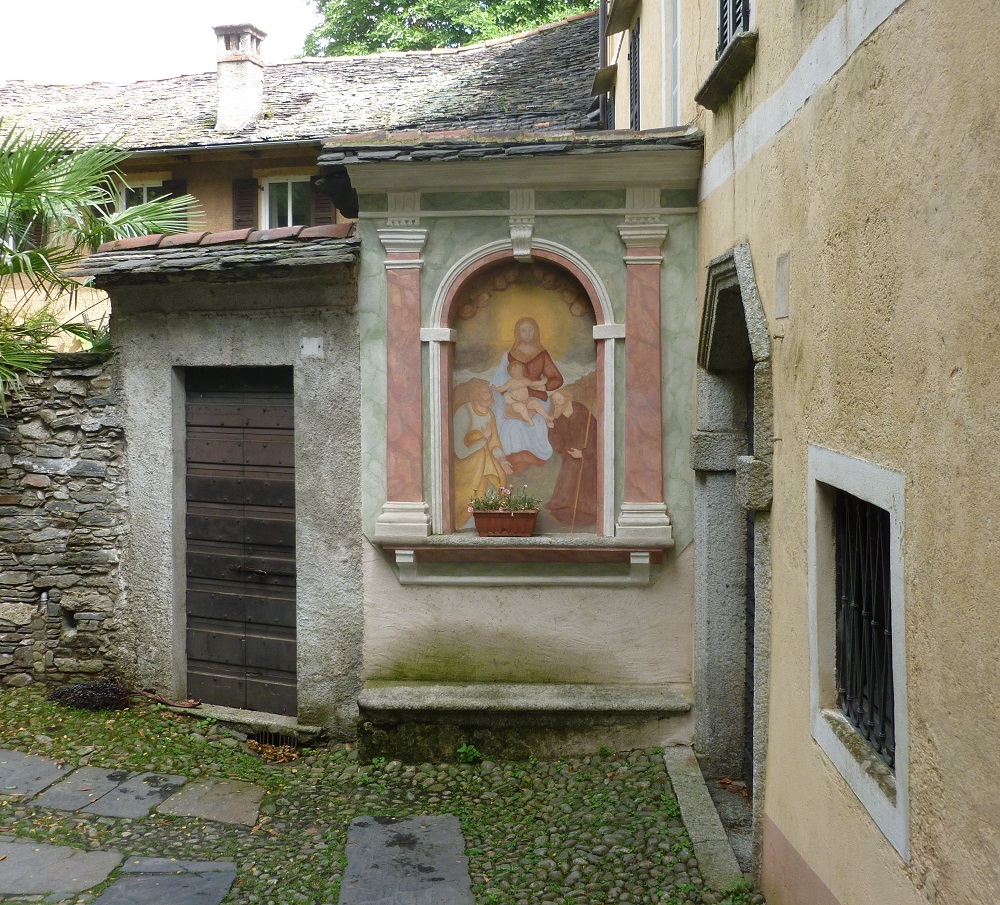
Continuing down the narrow walkway, we came upon this fresco of the Madonna and Child.

We also saw this patio, with its row of arches.

We leave Isola San Giulio and explore more of the lakeside mainland in Part 2.

Wednesday, June 24, 2015

Milan, Part 2

After viewing Da Vinci's Last Supper, visiting La Scala, and walking through the Galleria Vittorio Emanuele II, we entered the Duomo di Milano.  This church is the third or fourth (depending on where you get your information) largest in the world.  After we entered, I got this shot from the inside back toward the altar.

Here's a small section of the floor.

This is the altar, with some organ pipes above and to one side, along with a modern light fixture support.

In one corner of the church is this statue of San Bartolomeo (St. Bartholemew), who is believed to have been skinned alive.

More on the Duomo may be found at Sacred Destinations, Wonder Mondo and Milano 24.

After leaving the Duomo, I ran across Thomas the Tank Engine in the adjacent square, and took a pic.

I later wandered down Via Dante, which led toward the Castello Sforzesco, in front of which is a statue of Giuseppe Garibaldi, who led the campaign to unite modern Italy, known as the Risorgimento.

Here's a closer shot of the Garibaldi statue.

I eventually encountered some shady characters, but made it back to the Piazza del Duomo.

I then got a shot of the Duomo's facade, and of course, the crowd.

That's all for Milan.  For the rest of the trip, it was back to the lakes.

Tuesday, June 23, 2015

Milan, Part 1

By far the largest city we visited on the entire trip was Milan, the second most populous city in Italy.  Our first stop in Milan was the Santa Maria delle Grazie church, to see Leonardo da Vinci's painting Last Supper, which is on a wall of the church's cenacolo ("supper hall", appropriately enough).  The cenacolo is climate-controlled, and entered through a series of small ante-rooms, separated by a set of timed automatic doors, and each slightly cooler than the preceding one.  To my surprise, there was another painting on the wall opposite the Last Supper, a Crucifixion of Christ by Giovanni Donato Montorfano.  As one can appreciate, photography within the cenacolo is forbidden, so the only evidence I have of my visit is my ticket.

After leaving Santa Maria delle Grazie, we visited the theater known as La Scala ("the staircase").  In an adjacent square was a statue of Leonardo himself.

La Scala includes a large lobby, of which this is a partial view.

We were guided into some of La Scala's many balconies.  From the one I was in, I could see the stage and the orchestra pit.

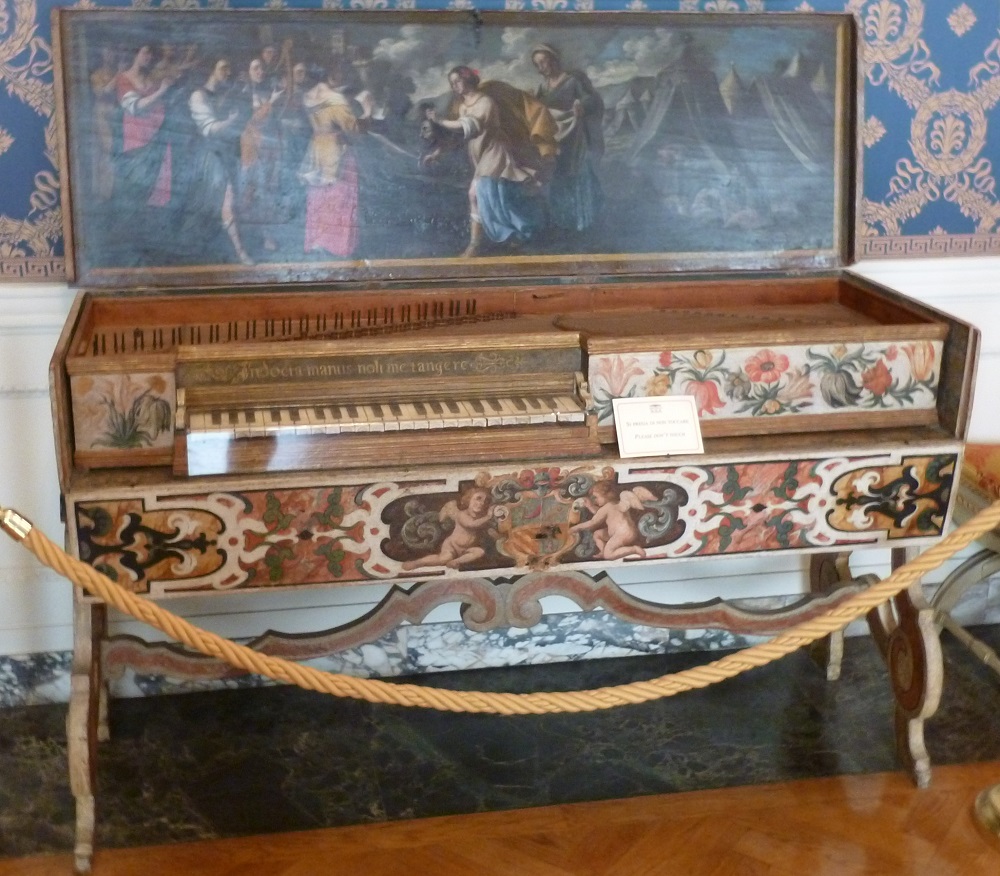
La Scala also includes some museum exhibits, such as these old instruments in a glass case.

This keyboard instrument is a spinet, an ancestor of the modern piano.

Near La Scala (and the statue of Leonardo above) is one entrance to the Galleria Vittorio Emanuele II, which contains shops and restaurants, all underneath a transparent roof.

The central area of the Galleria's floor includes several mosaics, such as this one honoring ancient Rome.

On the side of the Galleria opposite la Scala is a large square that includes this statue of King Vittorio Emanuele II.  As you can see, it was pretty crowded.

I'll have the rest of my visit to Milan in Part 2.  In the meantime, you can read more about Milan at Understanding Italy, Lonely Planet, About Travel and Wikitravel.

Ten Years After The Kelo Decision

Ten years ago today, the Supreme Court handed down its decision in Kelo v. City of New London, which upheld the city's seizure of private residences and condemnation of the entire Fort Trumbull neighborhood to make way for development by a private entity.  The case's namesake was Suzette Kelo, one of several residents who held out against the city.  The decision expanded (and arguably distorted) the Constitutional provision allowing governments to take private property for "public use", previously understood to involve governmental projects (roads, bridges, etc.), to include "public purpose", meaning that the seized property could be turned over to a different private entity on the potential of the transfer resulting in some kind of public benefit.

In the aftermath of the decision, Ms. Kelo and the other holdouts were given some additional compensation, and her house was moved to another location.  The development fell through, resulting in Fort Trumbull becoming nothing more than a big vacant lot, which it remains today.

Read more at The Orange County Register, Reason(dot)com, the Independent Sentinel, National Review and the Center For Individual Freedom.

Monday, June 22, 2015

Maryland Governor Diagnosed With Cancer

Maryland Governor Larry Hogan (R) announced today that he has non-Hodgkins Lymphoma, a cancer of the lymph nodes, which is now in stage 3 or "possibly" stage 4.  He will be undergoing a series of chemotherapy treatments and has expressed confidence that he will defeat the disease, while admitting that he will probably lose his hair.

Read more at The Washington Post, WUSA, WBAL, WJLA and The Baltimore Sun.

ABC's Dire Predictions Fail Miserably

Predicting the future is never easy, and can leave the prognosticator open to being spectacularly wrong.  An example of this, coming from ABC's Good Morning America, has been recently discovered by NewsBusters:
New York City underwater? Gas over $9 a gallon? A carton of milk costs almost $13? Welcome to June 12,  2015. Or at least that was the wildly-inaccurate version of 2015 predicted by ABC News exactly seven years ago. Appearing on Good Morning America in 2008, Bob Woodruff hyped Earth 2100, a special that pushed apocalyptic predictions of the then-futuristic 2015.
The segment included supposedly prophetic videos, such as a teenager declaring, "It's June 8th, 2015. One carton of milk is $12.99." (On the actual June 8, 2015, a gallon of milk cost, on average, $3.39.) Another clip featured this prediction for the current year: "Gas reached over $9 a gallon." (In reality, gas costs an average of $2.75.) [italics in original]
Although the NB post is ten days old, gasoline prices are still pretty close to $2.75 per gallon from what I've seen.  Since this is quite a bit lower than a year ago, my reaction is "Thanks a lot, you frackers!"

Read the full story.

Tatooine Podrace Veteran Fails To Outrun Earth Cops

It appears that Star Wars actor Jake Lloyd has gone over to the Dark Side, at least where his driving is concerned.  From the Richmond Times-Dispatch:
A former child actor who starred in one of the "Star Wars" movie sequels faces charges after leading South Carolina deputies on a high-speed chase.
Colleton County Sheriff's deputies on Wednesday arrested a 26-year-old man they confirmed through a former talent agent was Jake Lloyd, who played a young Anakin Skywalker in the 1999 movie "Star Wars: Episode I - The Phantom Menace," Sgt. Kyle Strickland said Sunday.
Lloyd, who identified himself as Jake Broadbent, allegedly hit speeds of more than 100 miles per hour, which is slow by podracer standards but well above most terrestrial speed limits.

Read more at the above link from RTD, and from The Independent and the Boston Herald.  As far as I know, there are no reports of Lloyd trying to force-choke the police officers or having a light saber in his vehicle.

Sunday, June 21, 2015

The Borromean Islands, Part 3

The third and last island in Lago Maggiore that we visited is Isola Bella (beautiful island), which like Isola Madre, includes gardens and a palace.  We arrived near the north end of Isola Bella, from which we could look back at Isola dei Pescatori, including the Verbano, where we had just had lunch.  The trees between the Verbano and this viewing point at the north end of Isola Bella are on a separate island, Isola La Malghera, which is tiny and uninhabited.

Cannons protect an artificial harbor, which at one time was for the private use of the Borromeo family.

The palace includes a large round room, of which this shot shows only a part.

The gardens include this terraced pyramid decorated by numerous statues, and of course, surrounded by tourists.

There was another flat area on the other side of the pyramid, with a few more tourists.

Like Isola Madre, Isola Bella had a few peacocks.  Unlike those Isola Madre, Isola Bella's peacocks were all white.

This one strutted his stuff.

After visiting the gardens, we went back to the boat for the ride back to Stresa, thus concluding a fun but tiring day of sightseeing.

The Borromean Islands, Part 2

As we continued walking around the gardens of Isola Madre, we came upon the birdhouse.  On its roof was a white peacock.

Meanwhile, back on the ground was a blue peacock.

Nearby was a peahen, who didn't seem to pay much attention to her male friends.

We eventually arrived at the entrance to the palace, in front of which is this Kashmir Cypress, which had been damaged in a storm in 2006.

We toured the palace, but photography inside was forbidden.  Back outside, we waited around a pond near a wall of the palace, along with some much younger visitors.

Also near the pond is this grotto formed by two staircases, at the top of which another tourist studies her electronic device.

We left Isola Madre and rode over to Isola dei Pescatori (island of the fishermen) for lunch.  During some free time afterwards, I spotted this guy swimming just offshore.

On the west side of Isola dei Pescatori was a small artificial harbor, on top of which stood this statue of Mary.

We later got back on the boat and set out for one more island, which will be shown in Part 3.