Wednesday, June 18, 2014

The World's Smallest Church

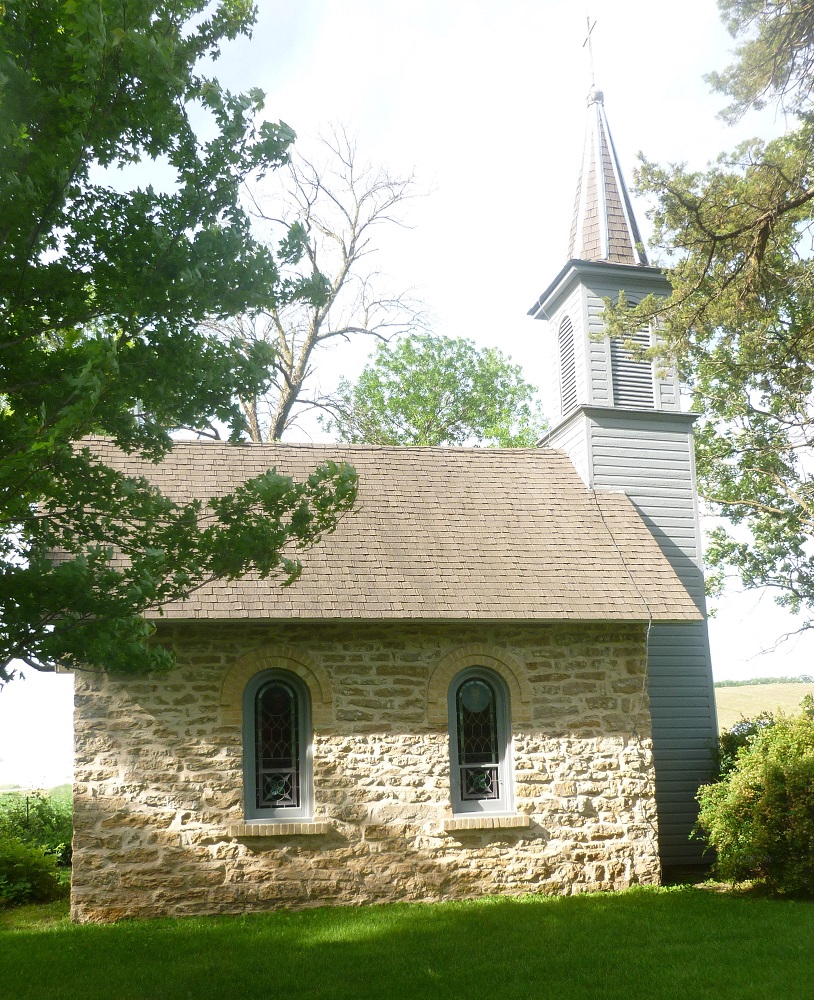
A few miles west of Festina, Iowa and just off a dusty gravel road is St. Anthony's of Padua Catholic Church, which is claimed to be the world's smallest church.  Inside, there are four pews, each of which looks like it could hold two adults.  Here's the view from the front.

Here's the church from the back....

....and from one side.

Within the church grounds is this cabin, which was moved from its original location about 10 miles away.  You can see the church and a statue in the background.


Burr Oak, Iowa

After visiting Winona, Minnesota, I turned southward and drove into Iowa, stopping at Burr Oak to see the Laura Ingalls Wilder Museum.  I was too late (just like in Winona) to catch any tour, but I did get to see the visitors center, which (as the sign indicates) was once a bank.

On the other side of the street from the old bank was the main part of the museum, which had at one time been a hotel.  Behind it was a park and this covered wagon.


Tuesday, June 17, 2014

Pro-Life Group Wins Free Speech Case

From The Washington Free Beacon:
A prominent pro-life group won a decisive victory against an Ohio state law that blocked a series of campaign ads during the 2010 election.
The Supreme Court unanimously ruled that Susan B. Anthony List (SBA List), a non-profit organization that supports pro-life candidates, had every right to establish billboards stating that a vote for Obamacare meant a vote for taxpayer funded abortion during the 2010 midterm elections.
Read the full story.

Monday, June 16, 2014

Onward To Minnesota

After the archaeological tour I was on came to its conclusion, I hopped into the trusty Bigfootmobile and drove westward across Wisconsin and into Minnesota.  Soon after crossing the Mississippi, I came upon a scenic overlook.  It wasn't very high above the highway, but it allowed me to see the King's and Queen's Bluffs, which are in Minnesota just south of the overlook, behind a grove of trees across the highway.

Further up the road, I found a place to pull off and look across the Mississippi back into Wisconsin.

After proceeding up to Winona, Minnesota, I took this pic of Sugarloaf Bluff, a local rock formation whose shape is partially the result of quarrying operations.

Winona has its own Polish Museum, but smutno, spóźniałem się (sadly, I was late) and it was closed.  I could only take a picture of the entrance.

The Polish community of Winona has their own Catholic Church, St. Stanislaus Kostka, popularly known as St. Stan's, which in 2011 was named by Pope Benedict XVI as a Minor Basilica.  It was tricky trying to take a picture of church without too many electrical wires or other buildings in the way, but here's the shot I was able to take.

Before this trip, my only contact with the state of Minnesota has been changing planes at Minneapolis International Airport.  According to a certain definition of having been somewhere, you can say that you've been to a place only if you have relieved yourself other than in the airport.  I'll spare you the details, but at last I can truly say that I've been to Minnesota.

Before I move on the next portion of my travelogue, let me make a culinary recommendation.  If you're on Interstate 90 in western Wisconsin, one place to stop is Burnstad's European Restaurant in Tomah.  For an appetizer, I recommend the chicken spaetzle soup.

UPDATE:  I learned in 2017 that Burnstad's has been permanently closed.

Tony Gwynn 1960-2014

Tony Gwynn, who played baseball for the San Diego Padres for his entire 20-year major league career, has died of salivary gland cancer.  Before turning pro, he had played baseball for three years and basketball for four years at San Diego State University.  As a major leaguer, Gwynn posted a career batting average of .338 and won 5 Gold Gloves.  After retiring from the Padres, he returned to SDSU to coach baseball.  Gwynn is survived by his wife, his daughter and his son Tony Gwynn Jr., who currently plays for the Philadelphia Phillies.

Read more at CNN, the Chicago Tribune, ESPN, NBC San Diego, CBS News and Fox News.

Sunday, June 15, 2014

Panther Intaglio And Aztalan Mounds

The Panther Intaglio, located in Fort Atkinson, Wisconsin, is what could be called a "mound in reverse".  Instead of a structure being raised and shaped into an effigy, an intaglio is dug into the ground, in the process being formed into a desired shape.  Archaeologists believe that the panther shape represents a water-dwelling spirit.  Two signs along a side street indicate the intaglio's location.

Here's part of the Panther Intaglio, which is next to an ordinary house.

The Aztalan Mounds are the featured attraction in Aztalan State Park, near Lake Mills, Wisconsin.  These mounds are platform mounds, similar to those at Cahokia in Illinois.  Archaeologists believe that Aztalan might have been an outpost of the culture that was centered at Cahokia, or perhaps a rebellious offshoot of Cahokia that set up their own capital.  To what extent the inhabitants of Aztalan were either migrants from Cahokia (or elsewhere) or indigenous to the local area is a matter of differing opinion among archaeologists.  Much of Aztalan, like Cahokia, was surrounded by a wooden stockade, part of which has been reconstructed, including this bastion.

Just beyond the bastion was the back of the largest mound in Aztalan.

Moving around to the side, we see that the mound has two levels.

Looking down to the other end of Aztalan, we see its other large mound, called the "mound of death" because of the burials found around it.

Moving still further around the first mound, we see two modern wooden stairways.  The largest mound at Cahokia, Monk's Mound, also has such stairways.


Casey Kasem 1932-2014

Casey Kasem, who was the original host of the radio show American Top 40 and the voice of the character Shaggy on the cartoon Scooby-Doo Where Are You!, died earlier today of complications from dementia.  He recently had gone missing, but turned up in Washington state.

Kemal Amen Kasem was born on April 27, 1932 in Detroit to parents who had immigrated from Lebanon and worked as grocers.  Kasem graduated from Wayne State University and worked as a radio disc jockey and announcer, including a stint in the Armed Forces Radio Korea Network after being drafted into the U.S. Army.  He hosted American Top 40 from 1970 to 1989, and again from 1998 to 2004.
Kasem was married twice, first to Linda Myers (1972-1979), with whom he had three children, and then to Jean Thompson (1980-2014), with whom he had his fourth child.

Read more at the New York Daily News, Entertainment Weekly and The Hollywood Reporter.

Saturday, June 14, 2014

Mounds At A Mental Hospital

The Mendota Mental Health Institute in Madison, Wisconsin was built on a plot of land that already contained several groups of effigy mounds.  Its buildings were thus located to keep the mounds intact.  Because of the nature of the place, we were advised not to go wandering off during our visit.

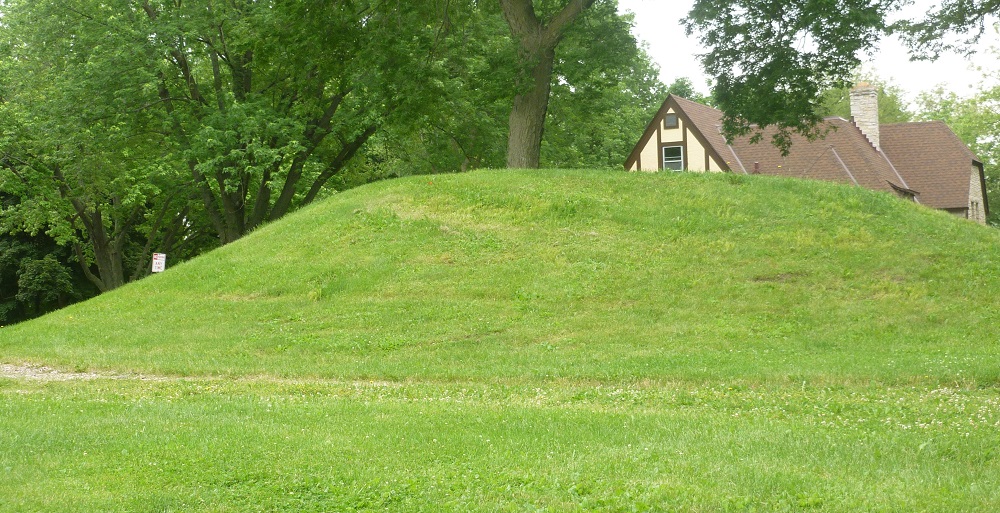
This group of conical mounds is located near the old superintendent's house.

These two trees are rooted in one end of a mound that is thought to represent a bear as seen from above, in other words, an "aerial view bear".

Here's a closer view of the largest of the three conical mounds, with the old superintendent's house behind it.

In another part of the MMHI grounds is an effigy mound with a long curved "tail", with trees growing out of it.

These straight embankments with sharp corners form part of a bird effigy mound.

This is part of another bird effigy.

This two-lobed mound is thought to represent a small animal such as a beaver.  The trees are not growing on the mound, but are behind it.

A mental institution might seem an odd place to find Indian mounds, but 12 years ago, I visited a site that I would consider even more unusual, a golf course.

Man Mound

Just northeast of Baraboo, Wisconsin is the only remaining effigy mound in the state that is shaped like a human.  The "head" of the mound includes two protrusions which are sometimes referred to as "horns".  The mound and its namesake park are located just off its namesake road.  Here are two signs next to the mound.

This shot looks up from the "legs" of the mound.  The two ladders were set up near the "head", to give a slightly elevated view for anyone making a short climb.

During the construction of Man Mound Road, the "feet" and lower parts of the "legs" were destroyed.  The white paint indicates where they used to be.

Across the road were some local residents.

This last shot was taken after climbing one of the ladders, and looks down from the "head" of the mound.  The two "horns" can easily be seen.


Friday, June 13, 2014

A Swing Into Iowa

After viewing several mound sites in Wisconsin, we went over to Iowa, to visit Effigy Mounds National Monument and Pikes Peak State Park, both of which are close to the Mississippi River.  Looking east from the visitor center at Effigy Mounds NM, the closer body of water (with the two men fishing from their boat) is Bluegill Pond.  On the other side of the railroad tracks is the Mississippi, beyond which is Wisconsin.

This group of conical mounds is a short walk from the visitor's center.

This path leads up to several groups of mounds within Effigy Mounds NM.  We didn't get to see any of them because the bus could not (and did not try to) travel on the back road leading to them.

Over at Pikes Peak SP, the Bear Mound was a short distance from the parking lot.  Here's part of the mound, mainly the lower part of the "bear".

Some archaeological tourists take a walk around the "bear".

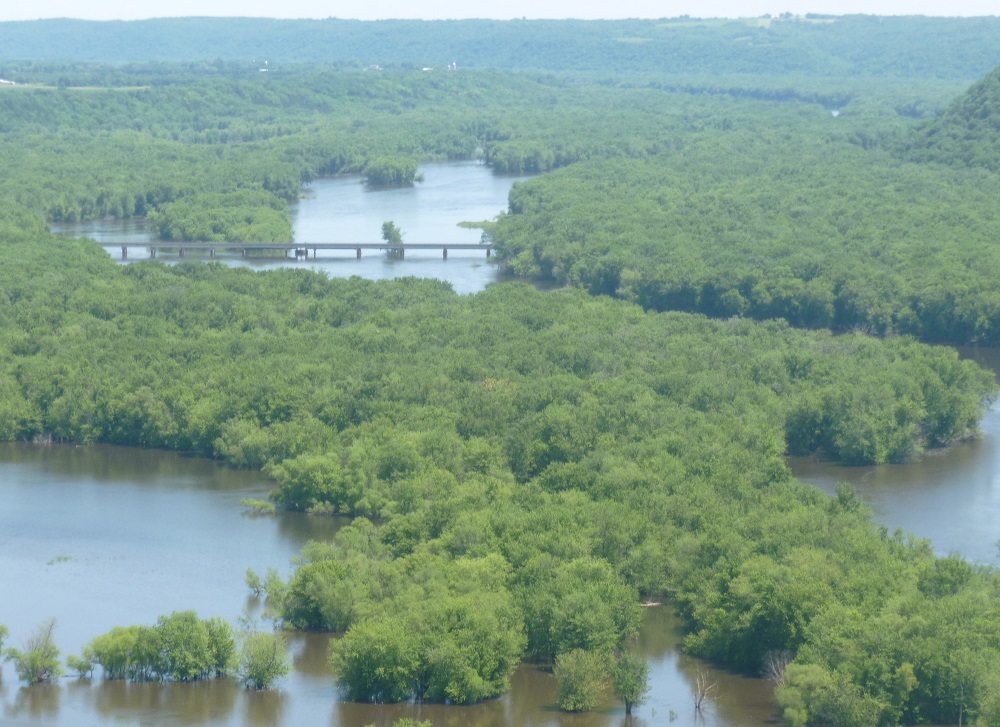
Pikes Peak is set on a bluff above the Mississippi, and thus included some great viewing areas.  This view looks north, with Prairie du Chien, Wisconsin in the background.

Looking east, we could see a railroad bridge span the mouth of the Wisconsin River as it empties into the Mississippi.