Monday, May 15, 2017

Two Flags

Click on this link to see the flag of Indonesia, which is the world's largest Muslim country by population.

Click on this link to see the flag of Poland, where only 0.4% of people are not Christian (although 10.8% are "unspecified").  This would mean that in Poland, Muslims constitute but a fraction of 0.4% of the overall Polish population.  Today, unlike many European countries, Poland is not welcoming migrants from Muslim countries.  Back in 1683, the Polish king Jan Sobieski defeated the (Muslim) Turks at Vienna.

If you've clicked on both links and looked at both flags, you'll see that the flag of the world's largest Muslim country, and the flag of a country that has often defended itself against Muslims, are each upside-down from the other.  Coincidence?  Sądzę że nie.  (I think not.)

Sunday, May 14, 2017

Links For Mother's Day

Happy Mother's Day to all you mothers out there.  Here are some things your kids have been up to lately:

From FaithZette, President Trump speaks at Liberty University.

From Breitbart's Big Government, the leftwing media gets their "lighten up, Francis" moment.

From The Daily Caller, this time, there will be nyet reset.

From Twitchy, the White House gets a lot of visitors who are (gasp!) rich GOP guys.

From ABC News, U.S. Ambassador to the United Nations Nikki Haley says that Trump can "fire anyone he wants".

From The Hill, Secretary of State Rex Tillerson says he has "to earn Trump's confidence every day".

From i24 News, Israeli Prime Minister Netanyahu reaffirms his country's position that the American embassy should be moved to Jerusalem.

From the Los Angeles Times, "Spicy" returns.

From The Washington Times, Nevada Democrats seek to raise the state's minimum wage.

From Philly(dot)com, Philadelphia's Democrats get ready to vote in their primary for District Attorney.

From Sputnik News, Latvia plans to build a border fence.

From Sky News, a Chinese railroad worker prevents a suicide.  (via Fox News)

From Life News, according to NOW's president, a procedure that takes life saves lives.

From the Sunday Express, European commission President Juncker takes a swipe at Brexit.

From Russia Today, according to UK Foreign Secretary Boris Johnson, his country might be getting money from the EU instead of vice versa.

From Deutsche Welle, Germany and Italy propose an EU mission to keep migrants from entering Libya, before they can cross that country to reach Italy.

From AhlulBayt News Agency, was a terror attack against Iranian border guards aided by Riyadh?

From Breitbart London, some Swedish authorities admit that mass immigration is causing economic problems.

From Leading Britain's Conversation, political correctness allows rape grooming gangs to prosper.

And from CSN Philly, former Virginia Tech quarterback Jerod Evans's time with the Eagles has been very short.

Saturday, May 13, 2017

Brief Music Break

A while back, I wanted to include Sometimes by Fleetwood Mac in a Music Break post, but the YouTube video had become unavailable.  Today, I was able to find another video of that song.  The reason for my renewed interest is that today is the 67th birthday of the song's writer and singer Danny Kirwan.  The song, in my opinion, shows some country influences, especially with Kirwan's lead guitar, and the acoustic rhythm, played by Kirwan and/or Bob Welch.  Christine McVie adds a happy-sounding piano part.  Sometimes was included in the band's 1971 album Future Games.


Although he's now 67, Kirwan is still younger than all of Fleetwood Mac's current members, who achieved great success during the late 1970's.  In related stories, Ultimate Classic Rock reviews Bare Trees, their last album with Kirwan, and Observer has a story about his time with and departure from Fleetwood Mac.  Happy Birthday, Danny, wherever you are.

Thursday, May 11, 2017

Return To, And From, Antwerp

The last place I visited before returning home was Antwerp, Belgium.  I had also been to Antwerp in 2005, on the same trip when I stayed in Brugge.  Across the street from where our ship was docked, but down a few blocks, was the Entrepot du Congo (Warehouse of the Congo), where goods shipped from the Belgian Congo were stored after arriving in Belgium.  (The story of this colony, the predecessor of today's Democratic Republic of the Congo, is quite ugly.)

Looking down the street just north of the Entrepot, we saw the Cathedral of Antwerp looming over several smaller buildings.

This fortress is called Het Steen ("the stone") because it was the first stone building in the city.  Today, it's besieged by tourists, although the couple on the right appear to be locals.  The statue is of the Lange Wapper, a demon found in various folk tales.  Read more about him here.

This bay window overlooks the interior courtyard of Het Steen.

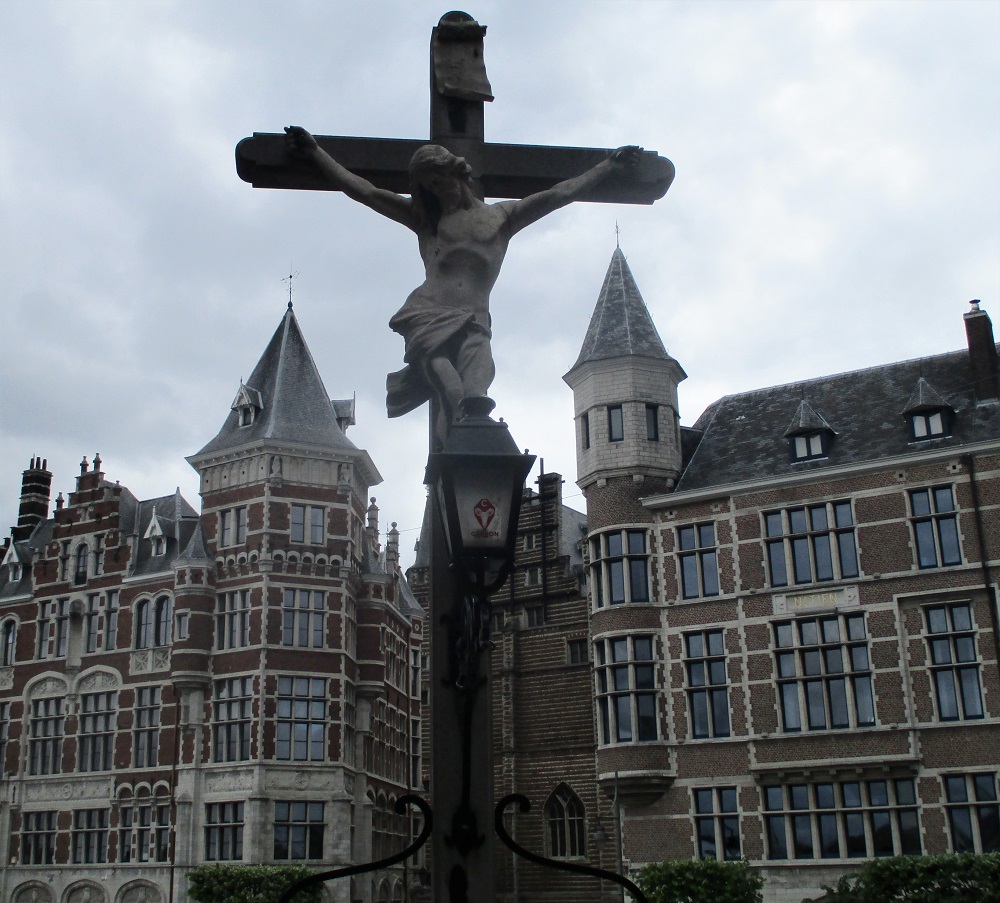
The courtyard includes this crucifix.

Walking toward the center of town, we came upon the Vleeshuis ("meat house"), which is now a museum of music.  One person on the tour said that its striped exterior reminded her of bacon.

After walking around various parts of downtown Antwerp, we saw another view of the Cathedral, looming over the alley we were in.

For more on Antwerp, go to Planet Ware and Lonely Planet.  This was our last full day in Belgium.  It was soon time to have a farewell reception, pack up the suitcases, and get ready for the bus ride back to Schiphol Airport and the flight home.  Thus ends my Netherlands-Belgium travelogue.

Return To Brugge, Belgium - Part 2

After touring De Halve Maan (The Half Moon) brewery, we resumed walking northward toward the central part of Brugge.  On the way, we saw these two columns, which look like they could be the remnants of something the Romans built.  Unfortunately, I have not been able to learn anything about them or what they once might have been part of.

People waiting for a boat ride formed a very long line.  I don't think any of my tour group was willing to do likewise.

Here's part of the main square, known as Markt.  The statues are of Jan Breydel and Pieter de Coninck, who fought against the French in the 14th century.

As I had done 12 years earlier, I walked to the eastern side of the city to the Kruispoort gate.  This is the inner side thereof.

Just north of the Kruispoort were two windmills.  This one is to the north of the other, and is surrounded by a small park.  I don't know if the fence is temporary or permanent.  A little research reveals that it's called the Sint-Janshuismolen (Saint John's House Mill).

The other windmill resembles a barn rotatable on a pivot.  It's called the Bonne Chièremolen, the name appearing to have some French influence.  (The French word bonne means "good", inflected to show feminine gender.)  For more on the windmills of Bruges, go here.

This is the southern face of the Belfort (Belfry), just south of the Markt square, as seen from the building's courtyard.

We continued southward from the Belfort back toward where we had entered the city.  On the way, we saw these buildings next to yet another canal.

We got back on the buses and rode to Antwerp, where we again met our ship.  Most of the links I've been able to find about specific places in Brugge seem to come from Visit Bruges, but for more on Brugge/Bruges, you can also go to Trip Advisor, Planet Ware, Lonely Planet and UNESCO.

Wednesday, May 10, 2017

Return To Brugge, Belgium - Part 1

That's right, my visit to Brugge was a repeat.  I stayed there in 2005.  During that trip, Brugge was the base from which that tour group explored other parts of the country.  This time, Brugge was a full day tour, as we went between Veere, Netherlands to Antwerp.  (I visited Antwerp 12 years ago, too, but that will be another post.)  Because both French and Flemish (which is often regarded as a dialect of Dutch) are commonly spoken in Belgium, Brugge is also known by its French name Bruges.

We entered the city from the south and soon came upon Lover's Lake and its environs.

This tower was used to store gunpowder, and was located away from most other structures.  Now, it's besieged by tourists.

This is part of the Begijnhof, an enclosed area which once housed single women, many of them widows.  They often cared for the poor and the sick, but were not nuns, and took none (pardon the homonymic pun) of the vows required of actual nuns.  In other words, although living communally, they were secular.

This building sits right on one of Brugge's canals.

Brugge has more swans that you can shake a stick at.  But I wouldn't recommend shaking a stick at the swans.  It's probably illegal.

We toured the brewery known as De Halve Maan (The Half Moon), which I had also done 12 years earlier.  Here are some old kegs, bottles and machine components in one exhibition room.

We climbed a spiral staircase to a viewing area on the roof of the brewery.  Here's a view of the Sint-Salvator (Holy Savior) church and the surrounding neighborhood.

Looking in another direction, we see the church of Onze Lieve Vrouw Brugge (Our Lady Of Brugge), which is now a museum.  If my high school French is any help, it might also be called Nôtre Dame de Bruges.

We then climbed down from the roof and through several other rooms, some of the stairways being as steep as ladders, before each receiving a glass of beer which came with the tour.  If you ever visit De Halve Maan, be prepared to earn some of your calories.  Stay tuned for Part 2.

Wednesday Links

It's the middle of another week, and here's a bit of what's going on:

A Dutch politician tells the European Central bank to give the Netherlands back some money if they leave the Eurozone.

Desperately seeking Israeli apartheid.

Desperately seeking the right-wing terrorist.

Desperately seeking the new "Saturday Night Massacre".

One Senator has a possible new job for James Comey.

While other areas cut back, one part of the world wants more coal.

From the "you can't make this up" department, squirrels endure media bias.

Beware the accidental Tweet.

Microsoft present the Presentation Translator.

U.S. Representatives visit the Dalai Lama.

Here's some amazing historical ignorance.

The methane rule survives in the Senate.

What happened to Johnny Depp's millions?

Meet your Muslim neighbors in Northern Ireland.

In Indonesia, a gay couple faces the cane.

Pennsylvania has 12 of the 100 worst puppy mills in the United States.

The Rock for President.

And to finish, what makes a good grilled cheese sandwich?

Tuesday, May 9, 2017

Trump Fires Comey

President Donald Trump has just told FBI director Comey, "You're fired!"  The decision was based on recommendations from Attorney General Jeff Sessions and his deputy Rod Rosenstein.

Read more at The Hill, Time, USA Today, Politico and Reuters.

Monday, May 8, 2017

Veere

Veere is a small resort town located on a peninsula in southwestern Netherlands.  The peninsula extends between the East Scheldt and West Scheldt estuaries.  The Veerse Meer (Lake of Veere) cuts into the peninsula, and contacts the northeast side of Veere.  On the southeast side is a channel called Buitenhaven (which might translate to "boat haven", if I'm permitted an educated guess), where our ship was docked.  On the northwest side is a marina.  Here is Veere's main commercial area, a street called Markt (which seems to be a common name for central squares in both the Netherlands and Belgium).

This is one view of Veere's Grote Kerk (Great Church), which is now a museum.

Due to the small size of the town, we easily reached the marina.

This enclosure houses an old cistern.  It's located across the street from the Grote Kerk, and just a short walk from our ship.

Here's another side of the Grote Kerk.

In the church's yard was a bunch of rocks.

This clock tower is part of what might have been the city hall.

I relaxed for a while in a park which includes this statue of Adriaen Valerius, a poet and composer who died in Veere in 1625.

This street goes through the park, and has a structure common in Veere.  The central part, made of bricks, has a more even surface than the rest, apparently intended for bicycles.  There is some kind of shop behind the wall.  On the bench, those aren't real children, but dolls.

The next morning, as we waited for our buses to show up, I could have sworn that I heard someone say "What's up, Doc?"

Soon afterwards, the buses arrived, ready to take us to Belgium.

Sunday, May 7, 2017

The Hague

The Hague is a city in southwestern Netherlands, situated on the North Sea coast.  It is the seat of the Dutch government and the provincial capital of South Holland, and is the location of the International Court of Justice and the International Criminal Court.  The city was once called des Graven hage ("the Count's wood" or "the Count's hedge"), which has evolved to s'-Gravenhage.  It is also known as den Haag ("the Hedge").  We arrived via a short bus ride from Delft.  Our first stop was at the Vredespaleis ("peace palace"), where the ICJ convenes.

The World Peace Flame is housed in this small monument near the Vredespaleis.  The stones around its base have been brought from many countries.

A peace dove was the motif for this bench.

This area is the Binnenhof ("inner court"), around which the city was built.  The main building once housed the Dutch parliament.  According to our guide, the ice cream man was always on friendly terms with the Prime Minister, and sometimes knew who the Prime Minister was going to be, even before he was elected.

Here's a bit of the Hague's skyline.

Our visit to the Hague concluded with a tour of the Mauritshuis, a museum of Dutch painting.  This is the facade.  To enter, we had to go down a stairway to the left.

There's more on the Hague at Wiki, Lonely Planet and Netherlands Tourism.  We eventually left the Hague and went to Schoonhoven, where we were reunited with our ship.