Thursday, May 31, 2012

Odds and Ends from Mississippi

Looks like I've finally gotten to the end of my photos from my trip southward.  These are from Mississippi, the last state we went through before heading home.

On US highway 61, just north of Lorman, is the Lorman Country Store, which sells many kinds of antiques and memorabilia, and offers a buffet lunch.  If you like to stuff yourself with some good old Southern-style food, this is the place to go.

To the east of Lorman is an old run-down house that was the center of a plantation known as Prospect Hill.  Some of the slaves at Prospect Hill were allowed to go to Africa to help establish what would become the country of Liberia.  Their story is recounted by author Alan Huffman in the book Mississippi In Africa.  This is one side of the house.

The interior of the house is also in bad condition.  The basement is full of worn-out junk, including three ruined pianos, with a fourth on the main floor.  Behind the house is a small graveyard, including this monument.

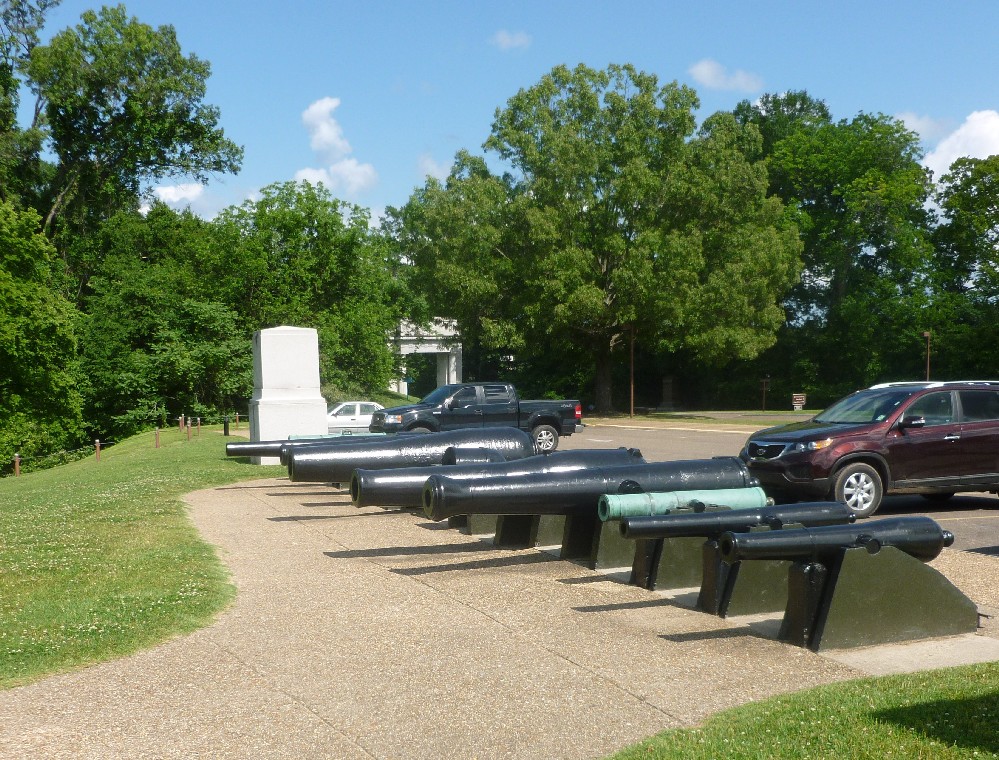
After leaving the Lorman area, we went up to Vicksburg, known for being taken by Union forces during the Civil War, after a long siege.  The outskirts of the city, where most of the fighting occurred, are now preserved as a National Military Park, which is strewn with monuments to the soldiers who fought there.  Like other prominent Civil War battlefields, the monuments are mainly identified with each state that was represented in the battle.  There was no opportunity to take pictures of most of the monuments, but before we went into the park, I found this row of cannons next to a parking lot.
Vicksburg Military Park includes the remains of the USS Cairo, one of the earliest ironclad ships.  The outer frame of the ship is a modern reconstruction, but much what is seen here was preserved in Mississippi River mud for about a century before being taken out.  Here's a front view.

The ship can be accessed by a walkway, which is just behind the man standing next to a cannon.

North of Vickburg, near Rolling Fork, is the house known as Mont Helena.  It was built in 1896 atop an Indian mound.  Today, it is used as a theater, and is also open for tours, which may come with a lunch or dinner.  I took this picture from our bus.

In downtown Clarksdale is the Ground Zero Blues Club, a restaurant and music joint owned in part by the actor Morgan Freeman.  The area north of Vickburg and between the Mississippi and Yazoo Rivers is known as the Mississippi Delta, and is widely recognized for the style of blues music that originated there.  There are indeed couches on the front porch.  Inside, customers are allowed to write on the walls.  In fact, it was hard to find a place for my own small contribution.

Finally, just beside Ground Zero are the railroad tracks, with a few parked railcars.


Wednesday, May 30, 2012

Odds and Ends from Arkansas

I still have some unposted pictures from my trip to the deep south, about half from Arkansas and the rest from Mississippi.  Thus, I'll group them into two posts, one for each state.

Near Parkin, Arkansas are the remains of a fortified Indian settlement known as Casqui, which are now preserved as a State Park.  While travelling around what is now the southern United States, Spanish explorer Hernando de Soto came upon this place and met its leader, who was also named Casqui.  At the time, Casqui and his people were in the middle of longstanding war against a somewhat larger group of Indians led by a chief named Pacaha.  Like Casqui, Pacaha lived in a fortified town, and also ruled over several smaller villages.  As he had done with Casqui, de Soto spent some time in Pacaha's main settlement.

Today, this sign marks the entrance to the park.

During his visit to Casqui, de Soto and his men raised a cross, possibly on this mound.  Behind it is the St. Francis River, which served as a transportation route for Casqui's people.  Part of the river was diverted into a ditch to create a moat around the Casqui settlement.

The Hampson Museum in Wilson, Arkansas is likewise a State Park.  Behind this sign are railroad tracks and a section of US highway 61 running parallel thereto, and which is named after football player and Arkansas native Cortez Kennedy.  The University of Arkansas has created a Virtual Hampson Museum.   In front of the museum is this sign.

It's a little tricky taking pictures of exhibits behind glass, but I think I did okay with these two shots.  This is a three-headed effigy pot.  Two heads are clearly visible, with the third behind the head on the left.

The other pic I'll just call AFLACK!


Tuesday, May 29, 2012

"Polish" death camp, Mr. President?

During the ceremony to present the Medal of Freedom to (among others) the late Georgetown professor Jan Karski, who had been involved in the Polish resistance to Nazi occupation during World War II, President Obama used the term "Polish death camp".  This choice of words was hardly noticed by most Americans, but over in Poland, shall we say, gniewają się bardzo.  (They're really pissed.)  As some in Poland have pointed out, the death camps were not Polish, but were established by the occupying Germans.

Read the story at the Buzzfeed.

Full disclosure:  By ancestry, I'm 1/4 Polish.  I have some knowledge of the Polish language, but not enough to effectively translate the quotes in the Buzzfeed article.  I have visited Auschwitz, including the Birkenau unit, which are in and around the Polish town of Oświęcim.  A few years back, Obama said that his uncle was in an American brigade that liberated Auschwitz, which is impossible because in reality Auschwitz was taken from the Germans by the Soviet army.  He later corrected himself and said that it was Buchenwald.

Monday, May 28, 2012

Harper's Ferry, Part 2

Two rivers meet at Harper's Ferry, and so do two railroad lines.  One of them proceeds southward, running along the Shenandoah, and is supported by a wooden trestle.  From the river, you can see the trestle and some buildings including St. Peter's Catholic Church.

The Real National Debt...

...is not what the government or the people owe to our respective monetary creditors, but what we owe to those who made the ultimate sacrifice to keep us free.  At least two political cartoonists have understood this truth.

From Nate Beeler via All Voices:

Winterville Mounds

I still have some mound-related pictures from my recent trip to the South.  One of the last places we visited was Winterville Mounds, a few miles north of Greenville, Mississippi.  While registered on the National Register of Historic Places, the site is maintained by the Mississippi Department of Archives and History.

This is the western side of the largest Winterville mound, with a smaller mound in front of it.

The eastern side includes a walkway to the top.

Ready for some exercise?  Here ya go!

I think that will be enough mounds for a while, but I have some other photos from the trip.  There were other types of places that were included in the trip.

Sunday, May 27, 2012

Harper's Ferry, Part 1

One nice thing about living in Maryland is the proximity to lots of historic places.  One of them is just across the Potomac River in West Virginia.  Harper's Ferry is known for John Brown's raid on the federal armory in 1859, but over 50 years earlier had been visited by Meriwether Lewis to obtain weapons and other supplies for his (and William Clark's) expedition to the west.

As Brown's raid deteriorated into failure, he and some of his men took refuge in the armory's small fire engine house, which would eventually become known as John Brown's Fort.  It has been moved from its original location, but today sits next to the intersection of Potomac and Shenandoah Streets.

On the other side of John Brown's Fort was a historical exhibition.

The Maryland side of the Potomac can be reached by a walkway attached to this railroad bridge.  The walkway is part of the Appalachian Trail, which runs through Harper's Ferry.

On the Maryland side is the Chesapeake and Ohio Canal towpath, which extends from Washington, DC to Cumberland, Maryland.  The canal (or more precisely, what's left of it) and towpath form a National Historic Park.  Near the Maryland end of the above bridge is the remains of one of the locks.

Here's part of Harper's Ferry as seen from the Maryland side.


Saturday, May 26, 2012

Brief Music Break

Just one song this time.  All the recent controversy over Senatorial candidate Elizabeth Warren (D-Mass), who may or may not be 1/32 Cherokee, has reminded me of this number from way back, by Paul Revere and the Raiders.

Friday, May 25, 2012

News and Notes

As the Memorial Day weekend gets underway, here are a few things I've run across today:

The Wall Street Journal notes that the Dow has had only 4 "up" days this month.  The last month with this few occurred over a century ago.  (There are still a days left in May, so this dubious distinction could still be avoided.)

The Jerusalem Post reports that Syrian troops have killed over 50 people in an attack on the town of Houla, including 13 children.

From Fox News, the Obama administration prepares a plan to vet some Syrian rebels so that they may receive arms from Arab nations.

From Breitbart's Big Government comes a biographical sketch about Senatorial candidate Ted Cruz (R-Texas), who has gained some support from the Tea Party movement.

Conservative Daily News reports on the dangerous tactics of "Speedway Bomber" Brett Kimberlin.  Who is Brett Kimberlin?  I confess that until today, I had never heard of him, but from what I gather, he doesn't like conservative bloggers.  StixBlog gives us some more information.

From Expose Obama, Democrats call Arkansas voters "racist" in response to the president's narrow primary victory in that state.

From the Mercury, mosquitos carrying the West Nile virus have been found in Pottstown, Pa.

From Boston.com, the privately-funded unmanned Dragon spacecraft has arrived at the International Space Station.  I'm sure that wherever she is, Anne McCaffrey is pleased.

From the USA Today, UN inspectors in Iran have found evidence that some uranium has been enriched to a greater degree than previously thought.

From SFGate, the German city of Hamelin once again has a problem with rats.

From MSNBC, a backyard party in Boxford, Massachusetts was crashed by beer-drinking cows.

And last but not least, in the Daily Jeffersonian, guest columnist Dan Speedy gives his thoughts on Memorial Day.

Tuesday, May 22, 2012

Emerald Mound

Located northeast of Natchez, Mississippi along the Natchez Trace Parkway, Emerald Mound is the second largest prehistoric earthwork in the United States.  The Mississippian ancestors of the historically-known Natchez Indians reshaped a natural hill into a platform having angled sides and a flat top almost 8 acres in area, and then built smaller "secondary" mounds atop the main mound.  Two of these remain, at its opposite ends.

Here's the view from the larger secondary mound to the smaller one, across the platform.

Down at the other end, atop the smaller secondary mound, a look back at the larger one.

This is a side view of the larger secondary mound.  Although this mound dwarfs the people standing on it or using the modern stairway, it's still tiny compared to the primary mound on which it sits.